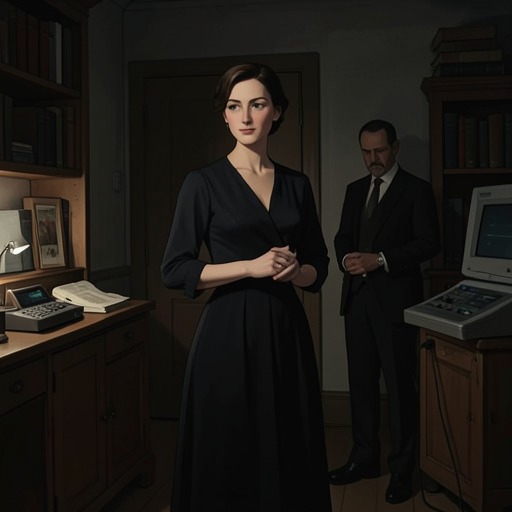
Early morning around four o'clock
The House of Bernarda AlbaThe around-four-in-the-morning hour becomes a fault line in the household: a report that Pepe el Romano was still at a window of Bernarda Alba’s house after four challenges Angustias’s account of their meetings and exposes how little anyone can verify behind the walls. The discrepancy does not settle what happened; it makes uncertainty itself a reason for Bernarda to keep watch.
A Report That Disrupts the Household
Poncia introduces the report while discussing the apparent intensity between Angustias and her fiancé. Her eldest son, passing along the street with yoked oxen, had seen them still talking at half-past four in the morning. Bernarda repeats the time in alarm. Angustias immediately calls the story a lie, then insists that Pepe has been leaving at one o’clock for more than a week and invokes God as her witness.
The competing times make the encounter more than neighborhood gossip. Angustias presents a settled account of the courtship; the report from the street places its conversation hours later, at a window of the house. The oxen give the story a specific witness and circumstance, but the witness is Poncia’s son, not a character questioned directly in the scene. What reaches Bernarda is hearsay, and the play preserves that distance even as the hour gives it force.
What Martirio Heard—and Did Not See
Martirio adds that she, too, heard Pepe leave at four. Bernarda asks whether she saw him with her own eyes. Martirio says she did not want to look out, then asks whether Angustias and Pepe now speak through the window facing the alley. Angustias answers that she speaks with him through her bedroom window.
Martirio’s response makes her knowledge pointed but incomplete: she confirms hearing a departure, not seeing Pepe or witnessing the conversation. The stage direction’s explanation sharpens the implication. Her admission that she heard him amounts to a virtual admission that she was standing by her own window, taking care not to show herself. The women’s windows therefore organize both access and concealment: Angustias names the place where she meets Pepe, while Martirio’s listening reveals a parallel act of watching without being seen.
The House, the Alley, and Uncertain Knowledge
Poncia urges Bernarda to take care that she does not discover the truth, while asserting that Pepe was at a window of the house at four in the morning. Bernarda presses her: is she certain? Poncia refuses certainty, observing that nothing in life is known for sure. The contradiction is central to the episode. Poncia sounds confident about the location and hour, yet immediately marks the limits of what can be known; Martirio’s hearing and Angustias’s account also stop short of proving exactly what took place.
The alley-facing side of the house helps explain how the scene can remain hidden from the street. The accompanying note identifies Adela’s room as likely situated on that side and observes that it offers her a way to speak with Pepe at less risk of being seen. Earlier, several young women watch Pepe from Adela’s room after he has turned off the main street, which Angustias’s room faces. The house thus has different lines of exposure: the street-facing room and the side alley permit distinct forms of approach, conversation, and surveillance. The late hour intensifies that arrangement without resolving who used which window on the reported night.
From Suspicion to Vigilance
The report changes Bernarda’s response from demanding an explanation to declaring an intention to watch. She says she was born to keep her eyes open and will now keep watch without closing them until she dies. In the English text, she reacts to the report with the repeated exclamation, “At half-past four!” The time becomes the point around which suspicion gathers, but her vow is not proof that she has uncovered the truth; it is a decision to monitor the household more relentlessly because the truth remains uncertain.
The episode’s force lies in that unresolved shift. A passerby’s account, Angustias’s denial, Martirio’s partial corroboration, and Poncia’s caution offer no single, complete version of the night. Instead, the hour exposes the house as a place where intimate meetings may be inferred from departures and windows, while certainty stays just beyond reach. Bernarda’s answer to that gap is vigilance, extending the household’s surveillance rather than ending its doubt.